The specification of a 200 tons per hour (TPH) sand production plant represents a critical threshold in the aggregate industry. It is a scale sufficient to service mid-tier commercial concrete batching plants, infrastructure projects, and local construction markets, yet it avoids the prohibitive capital outlay associated with mega-quarries. However, the configuration of such a sand making machine line is fraught with economic trade-offs. The objective is not merely to achieve the tonnage, but to do so while minimizing the cost per ton of finished manufactured sand. This requires a rigorous analysis of feed material characteristics, crushing and screening circuit design, and the management of fines. A suboptimal configuration leads to excessive recirculation loads, premature wear part consumption, and a product that fails to meet the gradation requirements for concrete aggregate. Conversely, a strategically engineered plant maximizes uptime, reduces energy expenditure, and produces a cubical, well-graded sand that commands a premium price in the market.
The lithology of the feedstock dictates the entire crushing strategy. For a 200 TPH sand line, the feed typically consists of either limestone, granite, basalt, or river gravel. Each material presents a distinct abrasion index and compressive strength, which directly influences the selection of the primary crusher. For materials with low abrasion, such as limestone, a horizontal shaft impact (HSI) crusher in the primary role offers high reduction ratios and produces a cubical shape conducive to sand making. However, for highly abrasive materials like granite or basalt, an HSI would incur prohibitive wear costs, necessitating a jaw crusher or gyratory crusher for primary reduction. The goal at this stage is to reduce the run-of-mine material to a manageable size—typically 150mm to 200mm—while generating a minimum of fines. Oversized primary crusher settings can increase the burden on subsequent stages, while overly fine settings reduce throughput and waste energy. The economic principle is to allocate the work of size reduction to the most wear-resistant machine available for each stage, preserving the more specialized sand-making equipment for the final shaping process.
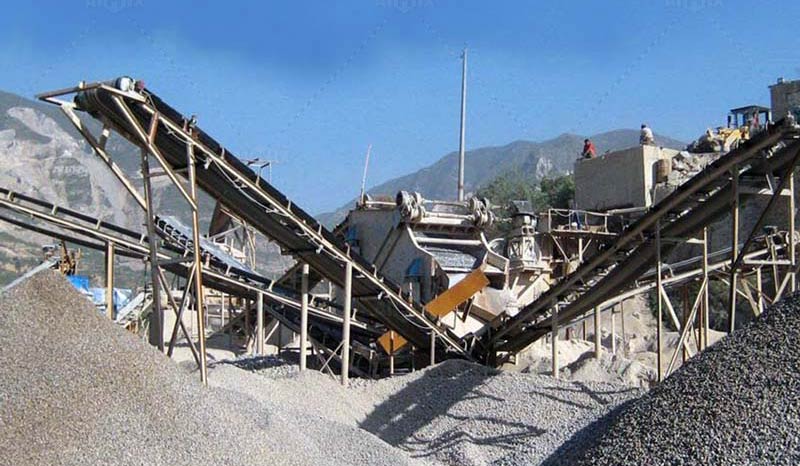
Between the primary crusher and the sand-making plant, the inclusion of a surge pile or bin is a cost-effective strategy often overlooked. A direct-coupled system, where the secondary stage is immediately fed by the primary, renders the entire line vulnerable to downtime. A blockage or maintenance event in the primary halts the entire operation. A surge pile of approximately 500 to 1000 tons of intermediate material decouples the two stages, allowing the primary to operate independently of the downstream plant. This ensures that the sand-making circuit, which represents the highest capital investment, can run continuously even when the primary is stopped for liner changes or clearing. Furthermore, it provides a buffer for feed material inconsistencies, allowing for a blended, homogenized feed to the sand plant, which stabilizes the operation and improves product consistency.
The heart of any modern manufactured sand line is the Vertical Shaft Impact Crusher (VSI), specifically a rock-on-rock configuration. Unlike horizontal shaft crushers, a VSI accelerates material via a rotor and throws it against a stationary anvil ring or a curtain of falling rock. This autogenous crushing action is critical for two reasons: it produces a superior cubical particle shape with high fracture faces, and it minimizes metallic wear, as the rock protects the machine components. For a 200 TPH target, the VSI must be paired with a screening and classification system capable of handling the volume. However, a standard VSI circuit produces a high proportion of material in the 4.75mm to 150-micron range, but also an excess of super-fines (minus 75 microns). Removing these fines is essential; in concrete, an excess of super-fines increases the water demand, compromising the mix design.

The method of fines removal presents a significant cost bifurcation. Wet processing using log washers and hydro-cyclones is highly effective at removing ultrafines and produces a clean, washed sand. However, it requires substantial water consumption—typically 2 to 3 cubic meters per ton—and necessitates the construction of settling ponds or the investment in filter presses to manage the sludge. This adds significant capital and operational cost. Conversely, dry classification using high-frequency vibrating screens and air classifiers eliminates the water requirement entirely. A dedusting unit, or air separator, draws the fine material away from the product stream using cyclonic air flow. While dry classification requires meticulous dust containment and can be less effective with certain clays, its lower operational expenditure makes it the preferred choice in arid regions or where water rights are expensive. The decision hinges on the local cost of water and environmental regulations regarding effluent discharge.
The efficiency of a sand line is measured by its closed-circuit performance. After the VSI and screening, the material larger than 4.75mm is deemed oversize and must be returned to the crusher. This recirculating load can vary from 30% to over 100% of the new feed rate. A high recirculating load indicates that the aggregate crushing machine is not reducing the material sufficiently in a single pass, wasting energy and increasing wear. Optimizing the rotor speed, cascade rate (the amount of material bypassing the rotor and falling directly into the crushing chamber), and screen aperture selection is essential to minimize this load. Modern VSIs with variable frequency drives allow operators to adjust rotor speed based on feed conditions, ensuring that the particle velocity is optimal for the specific material hardness. By balancing these parameters, a 200 TPH line can operate with a recirculating load that maximizes the production of finished sand while minimizing the tonnage passing uselessly through the circuit, directly improving the cost-per-ton metric and ensuring the plant's long-term economic viability.